eCommerce App Development | Build Your Own Online Store
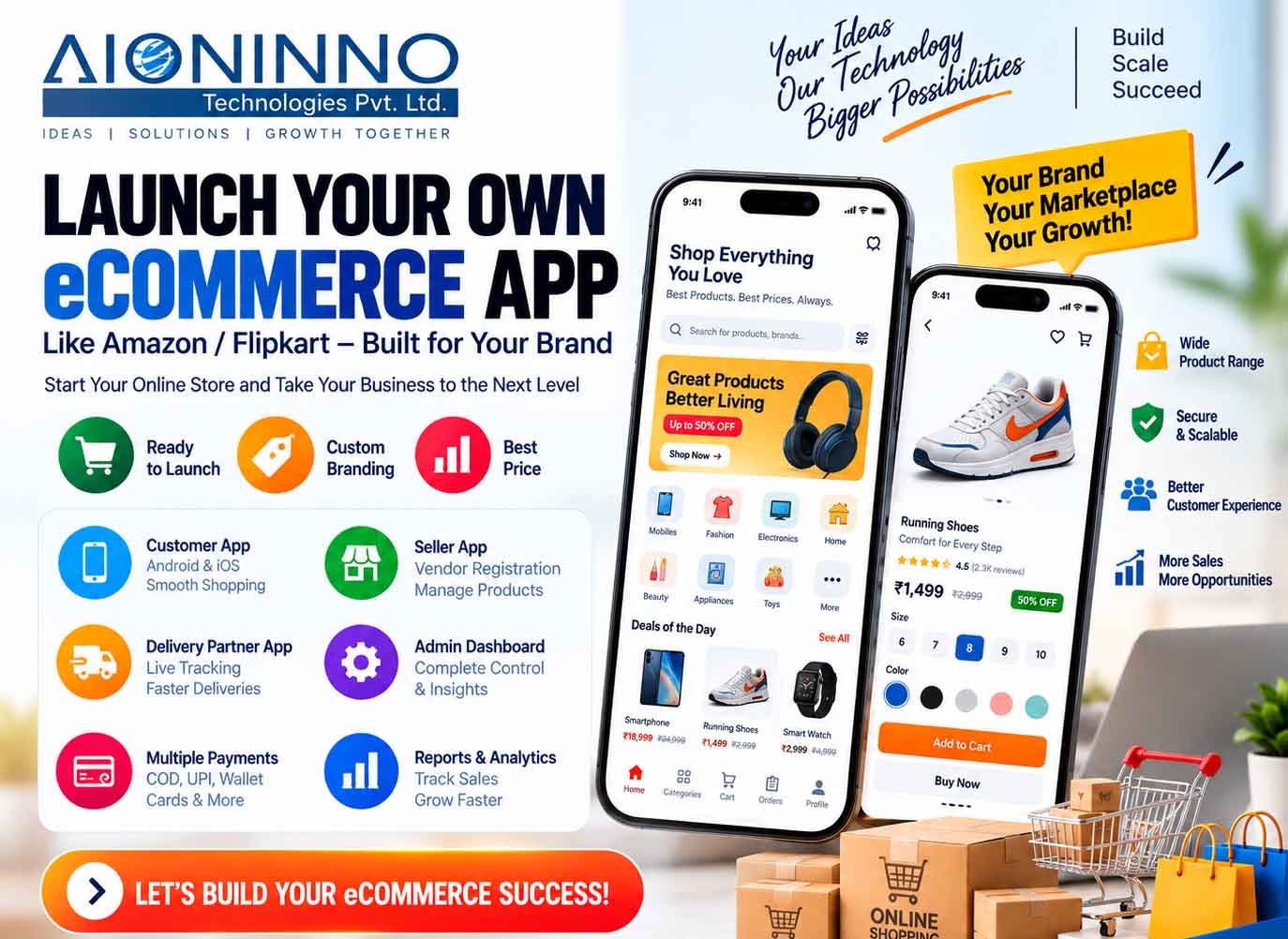
Build your own eCommerce app like Amazon or Flipkart with customer, seller, delivery and admin apps. Launch your branded online marketplace.
How to Build an eCommerce App Like Amazon or Flipkart: Complete Guide for Businesses
Have you ever thought about launching your own online shopping app instead of selling your products only through large marketplaces?
Whether you are a retailer, manufacturer, distributor, startup, entrepreneur, or an established business, having your own eCommerce website and mobile application can give you a direct digital channel to reach customers.
A modern eCommerce platform can allow customers to browse products, compare prices, place orders, make online payments, track deliveries, and manage their accounts from one place.
At the same time, sellers can manage products, inventory, orders, customers, and earnings through their own seller platform.
If you are planning to build an eCommerce app like Amazon or Flipkart, this guide explains the major features, applications, technology, development process, and important considerations.
What Is an eCommerce App?
An eCommerce app is a mobile application that allows customers to purchase products or services online.
A complete eCommerce ecosystem can include:
- Customer Mobile App
- Seller / Vendor App
- Delivery Partner App
- Admin Dashboard
- eCommerce Website
- Payment Gateway
- Product & Inventory Management
- Order Management
- Reports & Analytics
For a marketplace business, multiple sellers can register on the platform and sell their products to customers.
This makes it possible to create your own multi-vendor eCommerce marketplace.
Why Build Your Own eCommerce App?
- Your brand identity
- Customer experience
- Product presentation
- Offers and discounts
- Customer communication
- Loyalty programs
- Order management
- Payment options
- Seller commissions
- Delivery operations
- Business analytics
Many businesses start selling through existing marketplaces because they provide access to a large customer base.
However, having your own eCommerce platform gives you another direct channel for your customers.
With your own app, you can control:
Instead of building your business entirely around another marketplace, you can create a digital platform that belongs to your brand.
What Features Should an eCommerce App Have?
A professional eCommerce application should provide a smooth experience for customers while giving administrators and sellers sufficient tools to operate the business.
1. Customer eCommerce App
The customer application is the main shopping interface.
Important features can include:
- Customer registration and login
- Mobile OTP login
- Social login
- Product search
- Product categories
- Product filters
- Product sorting
- Product details
- Product images and videos
- Product variants
- Size and color selection
- Wishlist
- Add to cart
- Buy now
- Multiple delivery addresses
- Order placement
- Online payments
- Cash on Delivery
- Coupons and discount codes
- Order history
- Order tracking
- Ratings and reviews
- Push notifications
- Customer profile
- Customer support
The objective is to make the complete shopping process simple from product discovery to final delivery.
2. Seller / Vendor App
If you want to build a marketplace where multiple businesses can sell products, you need a seller management system.
A seller app can include:
- Seller registration
- Seller verification
- Store profile
- Product management
- Product categories
- Product pricing
- Product variants
- Product images
- Inventory management
- Stock updates
- Order management
- Order acceptance
- Order processing
- Sales reports
- Earnings reports
- Commission details
- Seller notifications
This allows multiple vendors to operate their stores through the same marketplace.
3. Delivery Partner App
For businesses managing their own delivery network, a dedicated delivery application can help coordinate deliveries.
Features can include:
- Delivery partner registration
- Document verification
- Online/offline availability
- Delivery requests
- Pickup details
- Customer information
- GPS navigation
- Live location tracking
- Delivery status
- Order history
- Earnings
- Notifications
This can help businesses manage last-mile delivery more efficiently.
4. Super Admin Dashboard
The admin dashboard provides centralized control over the entire eCommerce platform.
Administrators can manage:
- Customers
- Sellers
- Products
- Categories
- Orders
- Payments
- Coupons
- Offers
- Delivery partners
- Commissions
- Inventory
- Reviews
- Notifications
- Reports
- Analytics
- Website content
- Application settings
A powerful admin dashboard is especially important for a multi-vendor eCommerce marketplace.
What Is a Multi-Vendor eCommerce Marketplace?
A multi-vendor marketplace allows multiple sellers to register and sell products through one platform.
For example:
Customer → Marketplace → Multiple Sellers → Delivery → Customer
The platform owner can manage sellers and potentially generate revenue through:
- Seller commission
- Subscription plans
- Listing fees
- Advertising
- Featured products
- Delivery charges
- Seller services
This model can be useful for entrepreneurs planning to launch a marketplace for a specific city, industry, product category, or geographic region.
eCommerce App vs Multi-Vendor Marketplace
These two models are different.
Single-Vendor eCommerce
One business owns and sells the products.
Example:
Your Business → Customer
This is suitable for manufacturers, retailers, brands, wholesalers, and individual businesses.
Multi-Vendor eCommerce
Multiple sellers sell products through the same platform.
Example:
Multiple Sellers → Your Marketplace → Customers
This is suitable for marketplace startups and businesses that want to onboard multiple vendors.
Before development begins, it is important to decide which business model you want to operate.
How Much Does eCommerce App Development Cost?
One of the first questions businesses ask is:
"How much does it cost to develop an eCommerce app?"
There is no single price because development cost depends on the project's scope.
Factors include:
- Number of applications
- Website requirements
- UI/UX complexity
- Customer features
- Seller features
- Delivery system
- Payment gateway
- GPS tracking
- Product management
- Inventory management
- Multi-vendor functionality
- Third-party integrations
- Admin requirements
- Custom business logic
A basic eCommerce MVP will generally require less development than a complete multi-vendor marketplace with advanced seller, logistics, payment, analytics, and marketing systems.
The best approach is to define the required features first and then prepare a project-specific quotation.
How Long Does It Take to Build an eCommerce App?
The development timeline depends on the scope and complexity.
A typical development process includes:
Step 1: Requirement Analysis
Understand your business model, target customers, sellers, products, delivery model, and required features.
Step 2: UI/UX Design
Create the customer, seller, delivery, and admin interfaces.
Step 3: Backend Development
Develop APIs, database structure, authentication, product management, orders, payments, and business logic.
Step 4: Mobile App Development
Develop the Android and iOS applications.
Step 5: Admin & Seller Development
Build the dashboards required to operate the platform.
Step 6: Integrations
Integrate payment gateways, maps, notifications, SMS, email, shipping APIs, and other required services.
Step 7: Testing
Perform functional, security, performance, and device testing.
Step 8: Deployment
Publish the application and deploy the web platform and backend infrastructure.
Which Technology Is Used for eCommerce App Development?
The technology stack depends on the project requirements.
A modern solution can use:
Mobile App: React Native
Backend: Node.js
Admin Panel: React
Database: MySQL / MongoDB
Cloud Hosting: AWS
Maps & Location: Google Maps APIs
Payments: Payment Gateway Integration
This type of architecture can provide a foundation for building a scalable eCommerce platform.
Can You Build an eCommerce App Like Amazon or Flipkart?
Yes, you can build an eCommerce platform with similar types of functionality, such as:
- Product discovery
- Categories
- Search
- Shopping cart
- Checkout
- Payments
- Seller management
- Order management
- Delivery tracking
- Reviews
- Offers
- Notifications
- Reports
- Analytics
However, your platform should have its own brand, UI/UX, business model, features, and technology implementation.
The goal should not simply be to copy another marketplace.
The better approach is to identify the features your customers and sellers actually need and build the platform around your business model.
How to Start Your Own Online Shopping Business
If you are planning to launch an online marketplace, start with these questions:
1. What will you sell?
Choose your product category or marketplace niche.
2. Who are your customers?
Define your target audience and geographic market.
3. Will you sell your own products?
If yes, a single-vendor eCommerce platform may be appropriate.
4. Will other sellers sell through your platform?
If yes, consider a multi-vendor marketplace.
5. Who will handle delivery?
Decide whether you will use your own delivery partners or integrate with logistics providers.
6. How will you earn?
Consider commission, subscription, listing fees, advertising, delivery charges, or a combination of models.
7. What should the MVP include?
Start with the features necessary to launch and validate the business model.
Why Custom eCommerce App Development Can Be Useful
A ready-made solution may work for businesses with standard requirements.
But businesses with unique workflows may require custom development.
Custom eCommerce development allows you to define:
- Your business workflow
- Your commission structure
- Your seller rules
- Your payment process
- Your delivery model
- Your customer journey
- Your reports
- Your integrations
- Your branding
This can make the platform more aligned with your actual business requirements.
Build Your Own eCommerce App With AIONINNO
At AIONINNO Technologies Pvt. Ltd., we develop customized software and mobile applications for businesses and startups.
Our eCommerce solution can include:
Customer App + Seller App + Delivery Partner App + Admin Dashboard + eCommerce Website
We can customize the platform according to your business model, product categories, target market, delivery requirements, and growth plans.
Whether you want to launch:
- An online store
- A multi-vendor marketplace
- A local shopping platform
- A niche marketplace
- A B2C eCommerce platform
- A B2B marketplace
- A product delivery platform
the technology can be designed around your requirements.
Ready to Launch Your Own eCommerce App?
Your eCommerce idea can start with a simple MVP and grow into a complete digital marketplace.
If you are planning to build an eCommerce app like Amazon or Flipkart, start by defining your business model, required features, target customers, sellers, delivery process, and revenue model.
AIONINNO Technologies can help you convert that requirement into a customized eCommerce website, mobile app, seller platform, delivery system, and admin dashboard.
Let's Build Your eCommerce Business Together
AIONINNO Technologies Pvt. Ltd.
Ideas | Solutions | Growth Together
Call / WhatsApp: 7978788529
Website: www.aioninnotech.com
Email: contact@aioninnotech.com
Have an eCommerce idea? Contact us to discuss your requirements and get a customized development proposal.
